When I was eleven, there was a big Monet show at the Art Institute of Chicago. I was part of the tsunami of school kids poured into yellow buses and shipped to the big city to see it. Our art teacher talked up the Monet paintings. A new one had been acquired and it was quite the thing.
The new glorious painting was of haystacks. Having watched then read the Little House on the Prairie, I had a good idea of what haystacks were. These were not that sort of haystacks.
Haystacks, or grain stacks, or stacks of grain, or wheat stacks, or stacks of wheat, or the stacks, or, more properly, Les Meules à Giverny, are a series of twenty-five plein air paintings created in 1890 – 1891. Les Meules might have been stacks of wheat or oats or barley. In the typical Normandy manner, unthreshed-grains were stored in the round shaped stacks with steeply pitched self-thatched roofs. The stacks in his neighbor’s field captured Monet’s eye.
Repetition of a simple subject allowed Monet to focus on capturing fleeting ephemeral changing light, atmosphere and season – transforming common agricultural artifacts into transcendent visions. The paintings are a glorious study of light and atmosphere. The mundane unchanging subject matter provided a basis for Monet to show the nuances of his visual experience. They represent a pivotal moment in modern European art.
It’s hard to describe how different and monumental these paintings are. Time has worn smooth the radicalness of Impressionism. I’m pretty sure my mom had a Monet Waterlily poster in some pastel color room of our house.
The Art Institute of Chicago has the largest collection of Les Meules à Giverny. They have


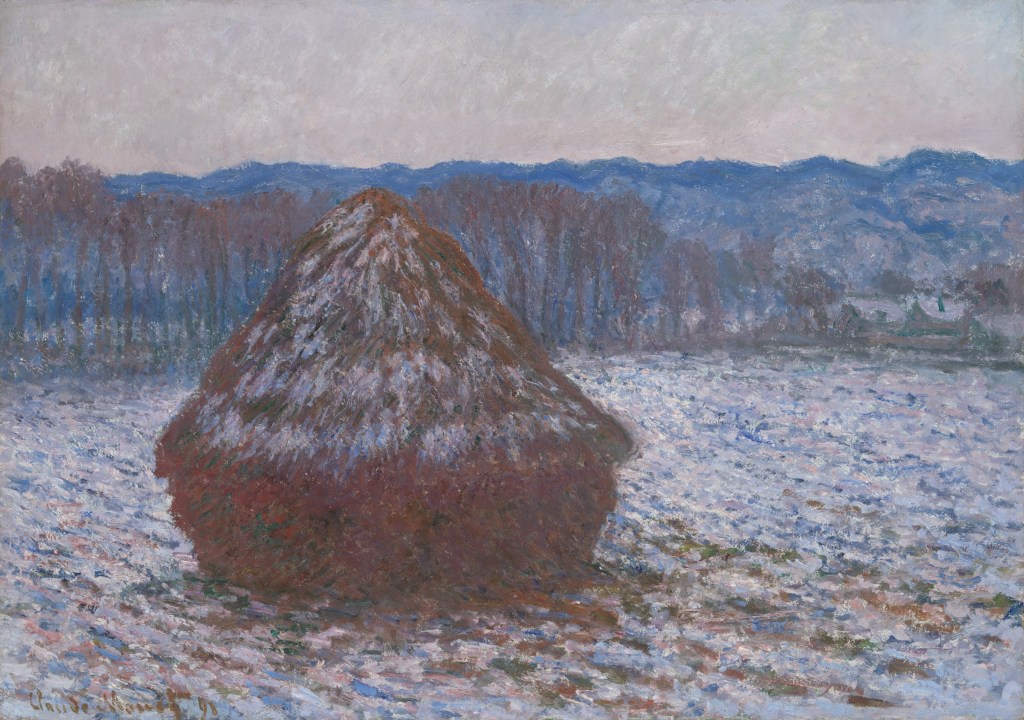

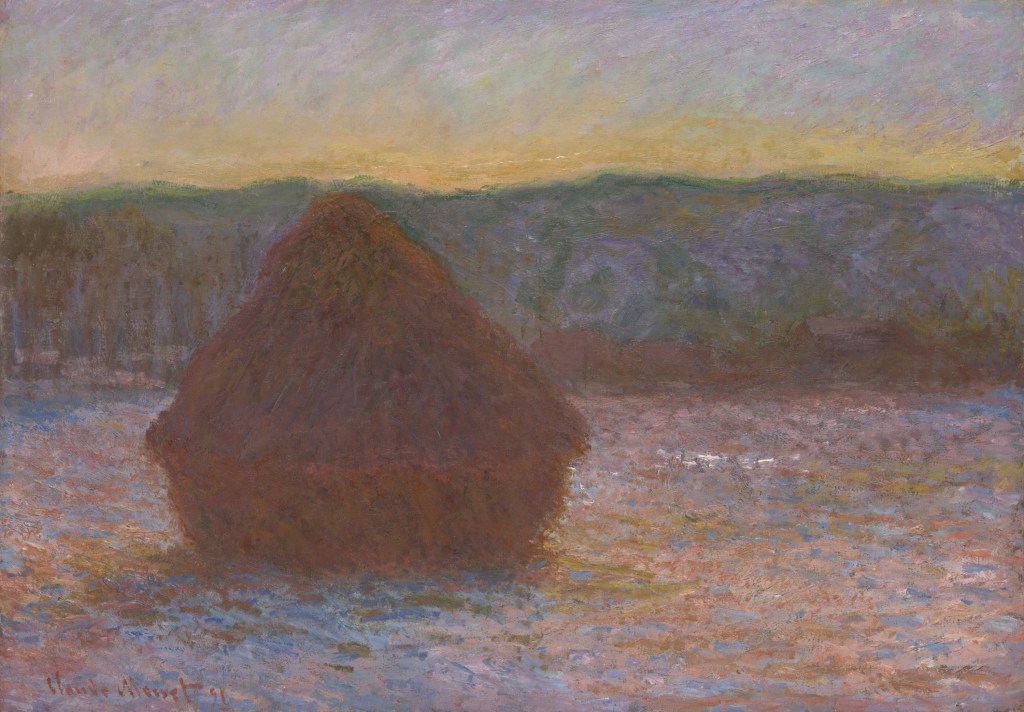
The Art Institute was bequeathed their first Les Meules à Giverny in 1921 by the Potter family of Marshall Fields and Company progenitor. Two more arrived in the 1930s – Stack of Wheat (Snow Effect, Overcast Day) and Stacks of Wheat (End of Day, Autumn). The next two arrived in 1983. Stack of Wheat (Thaw, Sunset), a gift, and Stacks of Wheat, a purchase. The last jewel in the set was gifted in 1985.
One of the Les Meules à Giverny sold in 2019 for $110.7 million dollars. It was the first impressionist painting to command more than $100 million dollars. At their first exhibit they didn’t make that much money, but did bring in enough to be financially successful and allowed the artist to buy the house and garden at Giverny. The famous water lily pond was built on the success of Les Meules.
The subtlety of the paintings was totally lost on grade school me. It was a lot of haystacks – a haystack book of hours. It was a long bus ride to the museum. It was loud and chatty in the mob of my fellow schoolmates. The museum was massive and in the big city of Chicago. We stomped by the paintings, pausing for a moment to gaze at glories of Impressionism then stomped off to giggle at naked people.
 code & carrot
Leave a comment