For half of my senior year of high school, I was without the family computer as it had moved to Colorado with my family. I had to use my mom’s electric typewriter and lots of whiteout.
I’d take it out of its hard plastic case and set it up on Grandma’s dining room table and plug it in, trying not to make a tripping hazard with the cord. While I could type at a moderate speed, my bad habits and poor spelling added hours to making a paper presentable.
My high school typing class was taught by the high school wrestling coach. His theory was to type as fast as you can and learn accuracy later. This translated into me learning to autocorrect my keying mistakes so often it became muscle memory. I still do it to this day. It’s peculiar – if I stop and think about how I’m typing or try to look at my hands, my rhythm is totally thrown off and can stay off for a chunk of time. In that situation, I have to move physically away from the keyboard to stop thinking.
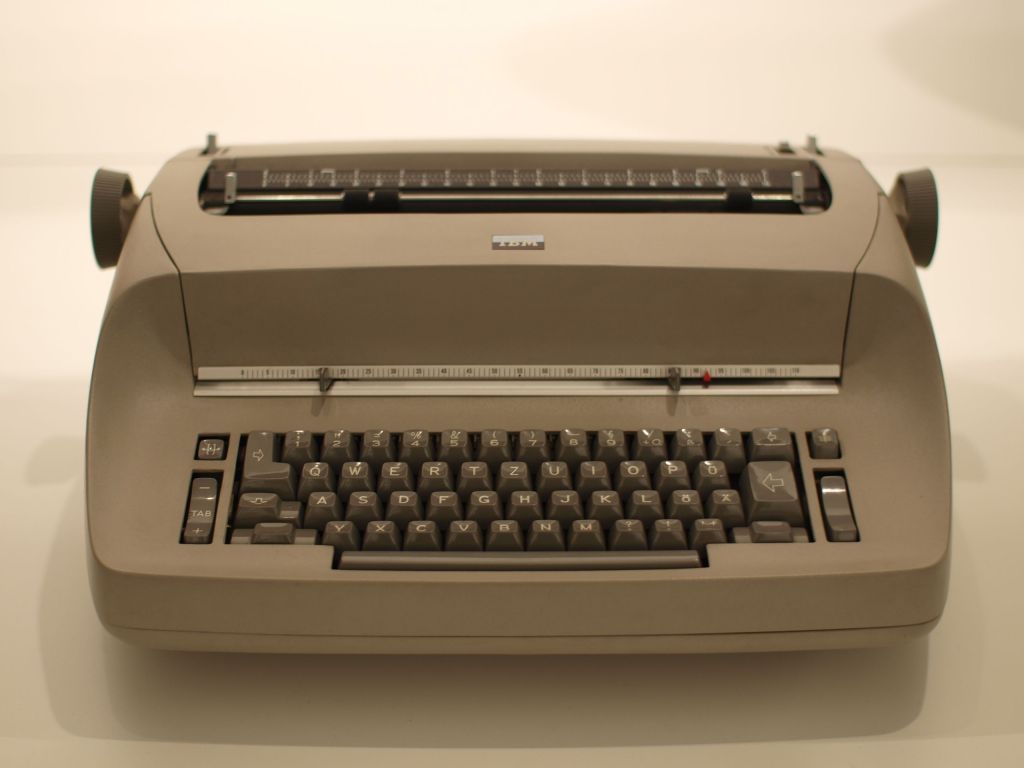
The typing room featured big heavy IBM electric typewriters. Nothing fancy about them at all. There were several models including the IBM Selectric typewriter with its smooth curves. It was a lovely machine compared to the other inelegant blocky machines. Selectrics hit the market in 1961 and by 1986 over 13 million had been sold.
The typing text book was designed to stand up with the covers forming an A frame. You’d stand up the book and type what was on the page. The goal was to do that without looking at the keyboard and go as fast as you could. In hindsight, it was really weird to type what you see in front of you out and turn it in for a grade. Speed drills were par for the course. There were lots of letters in the typing book. Formal business letters have gone the way of the rotary dial phone – it’s neat to see them but they aren’t a necessity anymore.
Coach never called it touch typing or ten finger typing but the goal was to type using all your fingers and not to look at them while you were typing. Fingers were placed on the row of keys below the QWERTY key row. I’m sure he lectured about the efficiency of resting your fingers on that row and maybe the benefits of this type of keyboard but both are lost in the depths of my brain.
I managed to mostly touch type in college and my career as a programmer. I never reached an impressive word per minute count. For a lark, I tried an online test and got 43 WPM with 90% accuracy. The other piece of typing class that is embedded in my head is pica and points which actually came up in my career while working on tax forms Pica as we all know is a unit equal to 1⁄6 of an inch or twelve points, usually measured vertically), en dashes and em dashes.
Two spaces between sentences is a hard habit to break when it’s been impressed in muscle memory. According to Wikipedia, those two spaces have become a thing reminiscent of the Oxford comma. I have no desire to read up on current style guides or relearn to type. This very post has two spaces between sentences. I’m sure there is a very clever way in this word processing program to adjust it but I just can’t be bothered and I like two spaces.
I’m surprised I got decent grades on those papers as they were riddled with stripes of white out and spelling mistakes. I’d have to retype entire pages if they were too bad. Thank GOD I didn’t have to use carbon paper to make duplicates for school. I missed the family PC and its word processor. I missed the old clackity dot matrix printer.
 code & carrot
Leave a comment